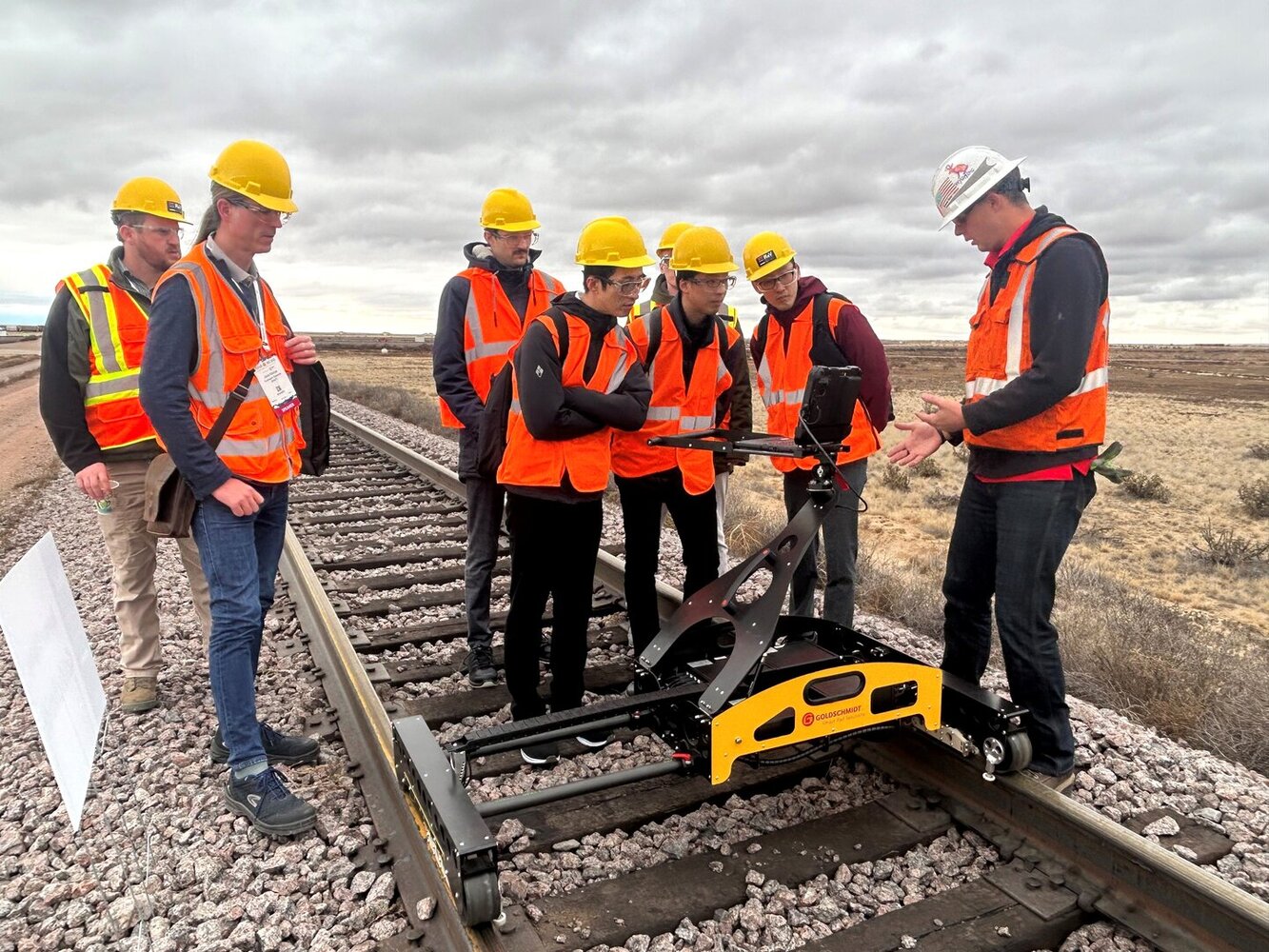

Rolling Contact Fatigue (RCF) is one of the greatest challenges in maintaining modern rail networks. At this year’s Rail Research Week in Colorado Springs (USA), Goldschmidt demonstrated how innovative inspection technologies and data-driven analytics can help detect and manage RCF at an early stage.
RCF is a wear phenomenon that leads to the formation and propagation of cracks in the rail head. If left untreated, this can result in severe damage such as head checks or squats, which compromise both the operational safety and service life of rails. With increasing network utilization, higher loads, and aging infrastructure, rail network operators face the challenge of ensuring safety and reliability despite limited budgets.
As part of the technical stream at the World Congress on Railway Research (WCRR), Michael Madden, President of Operations North America at Goldschmidt, presented data-driven and AI-supported approaches for optimizing rail maintenance.
These innovative RCF strategies and approaches were presented:
- Targeted maintenance: By using precise eddy current measurements and AI-assisted analysis, maintenance activities can be carried out exactly where they are needed. This reduces unnecessary grinding or milling, saves resources, and minimizes track downtime.
- Early detection: Modern inspection technologies make it possible to identify RCF at an early stage and address it proactively – before major damage or unplanned failures occur.
- Integrated approach: Combining eddy current with other technologies such as visual and ultrasonic inspection provides a comprehensive picture of rail condition and supports a predictive, condition-based maintenance strategy.
With these solutions, network operators can extend the service life of their rails, reduce maintenance efforts, and sustainably increase operational safety.
Goldschmidt is committed to international collaboration to further advance the development of inspection and analysis methods – especially for head-hardened rails.